

There's a nervous excitement. Visible is the cold breath exhaled by my competitors as they perform the "starting line" wiggle on the starting line.
A quick movement of the hips.
I'm lined up for my local 5km community parkrun and I'm focused. The countdown begins...
Hold on. I need to adjust my device. So does the person next to me.
The person behind us sighs. I won't start until… there! GPS ready, away I go.
In the mele, it's challenging to find a arm without a fitness tracker on it. And this isn't only us athletes who wear them.
It's a booming, massive industry. Brands like Garmin are prevalent, each with an wide range of different devices to fit a variety of needs. Based on how advanced the device you choose, price tags can start from a hundred pounds to thousands of pounds.
"It drives me insane, I can't stop checking."
"It comforts me… It's like a friend guiding me."
"I wish it wouldn't say I've had a restless night."
Just some of the responses I've had from fellow smartwatch wearers when I inquire what they think of theirs.
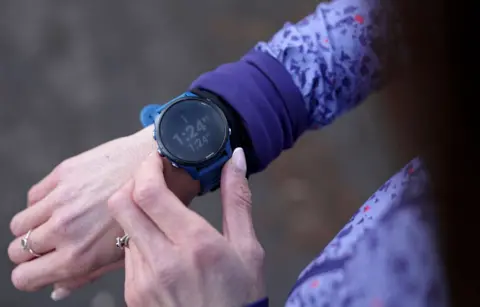
A Sea of Statistics
My feelings on mine? Right now, annoying. It's telling me my speed is wrong, leading me to doubt whether the overhead branches I'm running below are disrupting my GPS connection.
Countless individuals of us strap these small gadgets onto our wrists and keep them on all day and night, ostensibly at ease with the fact they're perpetually monitoring us.
Long past are the days when we relied on them solely to give us an rough count of our daily steps. Now, they can measure our nightly rest, heart rate, glucose levels, our VO2 max.
It's tricky to find a physical metric they fail to monitor.
But do they do what they say they do? And are the numbers we scrutinise a faithful picture of reality? Do they enhance our daily wellness, or do the avalanche of readings and motivational messages just contribute to our sense of overwhelm?

A Complicated Bond
"I become a quite obsessed with mine," one user confesses.
While she values how her device monitors her exercise, she finds some of its other functions "excessive" at times - a feeling that became apparent during a pregnancy.
Before she realised she could adjust the settings, her smartwatch repeatedly informed her she was not being productive enough. In a new phase, the watch insists her she's had a restless night.
"I've got a infant, I don't need to be told I've not slept," she says. "That fact is only too well."
Is it not possible to just remove it?
"I suppose I could, perhaps, but I'm in this push-pull dynamic with it," she continues. "I appreciate it for its workout tracking, but I'm unsure whether the additional features it can now do is maybe overkill for me."
Inside the Device
Each model of smartwatch has its own proprietary way of monitoring your vitals and interpreting your data, but the majority use optical sensors on the back of the watch.
They typically shine minute LED lights onto your arm which can detect capillary action, recording your heartbeat. More advanced devices measure changes in the bioimpedance that passes over the skin to get an idea of your stress levels.
A Fine Balance
A data scientist says that in general for smartwatches, it's a "difficult line" - while the continuously improving tech could realistically aid early diagnosis, "detecting disease before we show symptoms", it could also turn us device users into the "worried well".
He points out that newer wearables can conduct tests like medical-grade monitoring, which regularly monitor how healthy the heart is. They can alert if someone is experiencing a heart arrhythmia, where there is irregular electrical activity in the heart causing an arrhythmia.
This does not mean someone is imminently going to suffer a cardiac event, but it can give an preliminary indication they might be more vulnerable of a heart problem in the future.
But how to understand these numbers is complex. The expert fears that as more functions are added, people may find it hard to fully comprehend their data.
"I'm not entirely convinced that having the capacity to monitor so many things is such a good idea," he says.
A clinical psychologist specialising in patient behaviour agrees. A study into the influence of wearable tech on a set of heart condition patients suggested a noticeable percentage of those who were given devices to monitor their heart health experienced heightened worry and were "more inclined to use healthcare resources".
She identified a cycle with her patients - they spotted a worrying figure on their watch. They felt anxious. Their BPM rose. They got more worried. They checked again, and their reading rose further.
"When people are presented with numbers about ourselves that we don't really understand then, understandably, we are going to want to know more," the psychologist says. "We monitor, we re-check - it becomes a feedback loop."

